Who Google AI Overview cites in Ukraine: 2026 data breakdown
AI Overview changes the core rule of search: an assistant's answer has room for 1–3 sources, not ten positions. So a high Google position no longer equals presence in the AI answer. Below is a breakdown of what open data says about this, and what it means for a business.
This is not my own measurement, but an analysis of published figures: a large sample of Ukrainian results by Focus.ua and global industry benchmarks. All sources are named at the end.
The key point: per Focus.ua, in nearly one in five AI Overview answers every source was a Russian domain, and a Google top spot — per industry data — provides only a minority of citations.
The key numbers
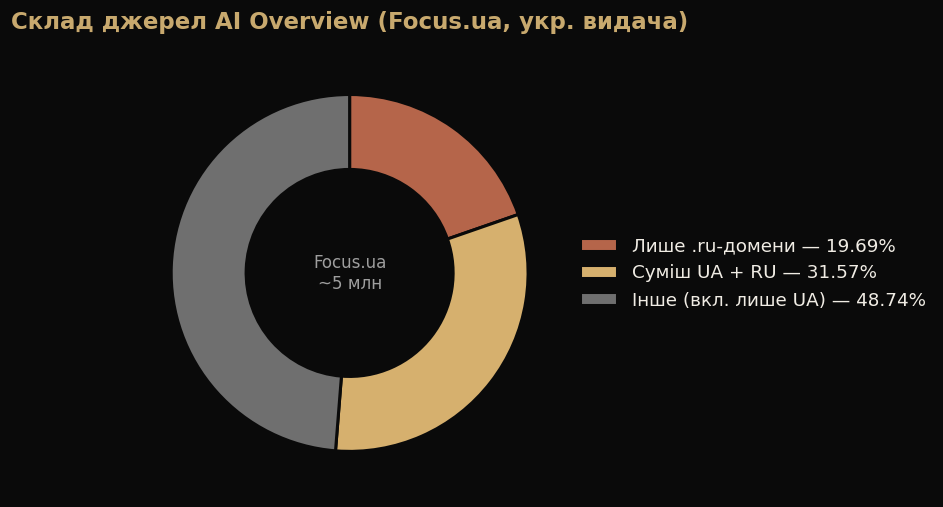
- 19.69% of AI Overview answers were built exclusively on .ru domains (Focus.ua);
- 31.57% — on a mix of Ukrainian and Russian sources (Focus.ua);
- 90.8% of answers were in Ukrainian for a Ukrainian-language query (Focus.ua);
- 5.01% of all citations went to Wikipedia — the single most-cited domain (Focus.ua);
- ~32% of Google queries show AI Overview at all (global benchmark);
- 92–96% of AI Overview sources sit outside the organic top-20 (global data).
Where AI Overview takes its sources
On the Focus.ua sample (~5M queries), the source split looks like this:
| Composition of an answer's sources | Share (Focus.ua) |
|---|---|
| .ru domains only | 19.69% |
| Mix of Ukrainian and Russian | 31.57% |
| Other (incl. .ua only) | 48.74% |
The practical takeaway is simple: where quality Ukrainian-language sources are missing, the model takes others more often. That's not a «conspiracy» but a content vacuum — and, at the same time, an open niche for whoever fills it with their own material. More on this — the problem of .ru sources in answers.
Does a Google top spot guarantee a mention in AI
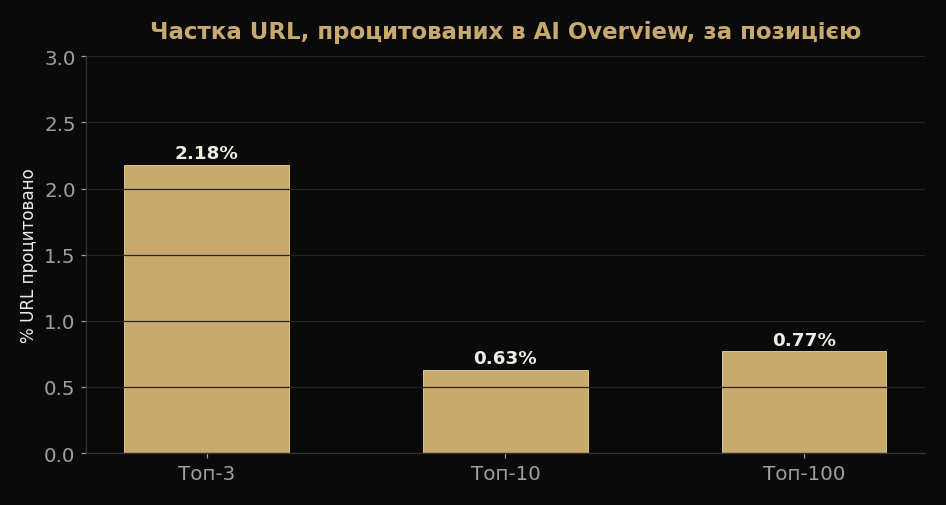
No. Per Focus.ua, only 0.77% of organic top-100 URLs got any mention in AI Overview; 2.18% from the top-3 and 0.63% from the top-10 were cited. Global data is sharper still: 92–96% of AI Overview sources don't rank in the organic top-20 at all.
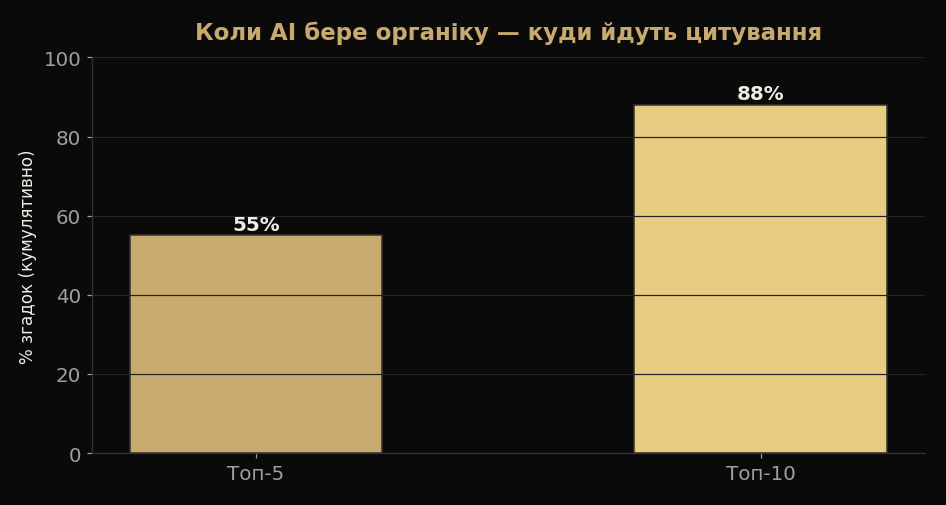
When the model does lean on organic, it concentrates at the top: per industry data, 55% of mentions go to the top-5 and 88% to the top-10.
Query language and sources
Focus.ua recorded a high language match: 90.8% of answers in Ukrainian for a Ukrainian-language query. So content language is a working lever: a Ukrainian-language page has better odds of appearing in an answer to a Ukrainian query. Comparing the sources themselves by query wording is still an open question — one I check case-by-case in niche audits.
Why a position no longer guarantees the answer
Beyond position, text extractability matters. By industry estimates, about 70% of people read only the first third of an AI answer, and models favor self-contained paragraphs with facts and numbers. A «wall of text» with no structure gets cited less even at a high position.
What to do about it
- Don't rely on position alone. A top-10 raises the odds, but most AI Overview sources sit outside the top-20.
- Run content in Ukrainian. Page language affects its odds in answers to Ukrainian queries.
- Cover topics that lack quality .ua sources. There the model takes other domains more often — an open niche for your own material.
- Wikipedia presence is not cosmetic. It's the most-cited domain, so a correct article on the topic really affects visibility.
- Make content extractable. Self-contained paragraphs with facts and numbers get cited more.
- Measure regularly. AI Overview is unstable — a snapshot ages, so repeat the check.
If you want to see how your site is represented in AI answers for your niche — I do that in an AI visibility audit on real prompts.
Sources
- Focus.ua publication (12 Aug 2026, by Kateryna Hordiienko) — a ~5M-query sample of Ukrainian results: .ru source shares, language match, citation by position, Wikipedia 5.01%.
- Global benchmarks for AI Overview frequency (~32%), organic overlap (92–96% outside top-20; 55% top-5, 88% top-10) and read depth — aggregated public data from 2024–2026 market studies.
Focus.ua figures are quoted from the publication; I claim no authorship of their sample. Global figures are industry benchmarks, not the result of my own measurement.
Who prepared this
The breakdown was prepared by Stanislav Bakhariev, a private SEO/AEO/GEO specialist since 2012. More on the approach — on the about page.